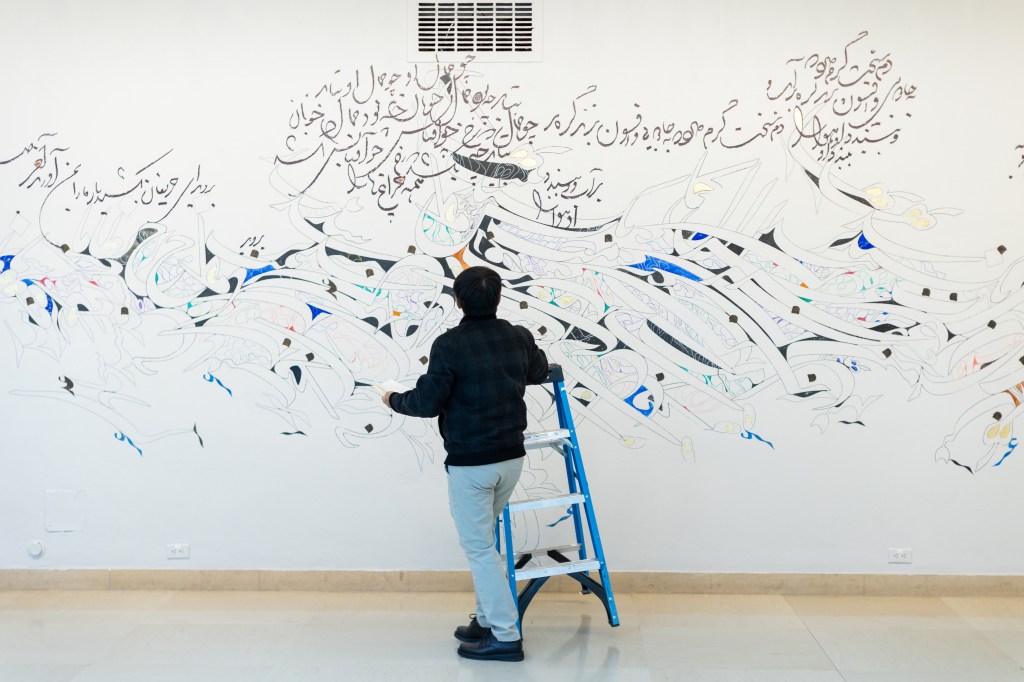
In Your Light presented a contemplative exploration of Persian/Dari calligraphy through the finest verses of Persian/Dari literature. The mural traced the evolution of calligraphic traditions developed over centuries, honoring both the discipline of practice and the expressive power of the written word. Calligraphy has long held a revered place in Islamic art due to the sacred significance of the written word, particularly in the context of the Quran. In Arabic, calligraphy is known as Khat, meaning “line,” reflecting the harmony between writing and design. For centuries, calligraphers have been regarded as guardians of cultural memory, transmitting poetry, philosophy, and spiritual thought across generations.
The roots of Persian/Dari calligraphy trace back to the 8th–14th centuries, when artistic exchange across the Persian Empire, encompassing modern-day Iran and Afghanistan, fostered a rich synthesis of Arab, Central Asian, and Indian influences.
During the Safavid period (1501–1736), calligraphy reached remarkable refinement. Master calligraphers such as Mir Ali Tabrizi and Sultan Ali Mashhadi shaped the development of Nastaliq, a script celebrated for its fluidity, elegance, and suspended movement. Often called the “Bride of Calligraphy,” Nastaliq became the preferred script for Persian/Dari poetry, perfectly embodying the lyrical beauty of the language.
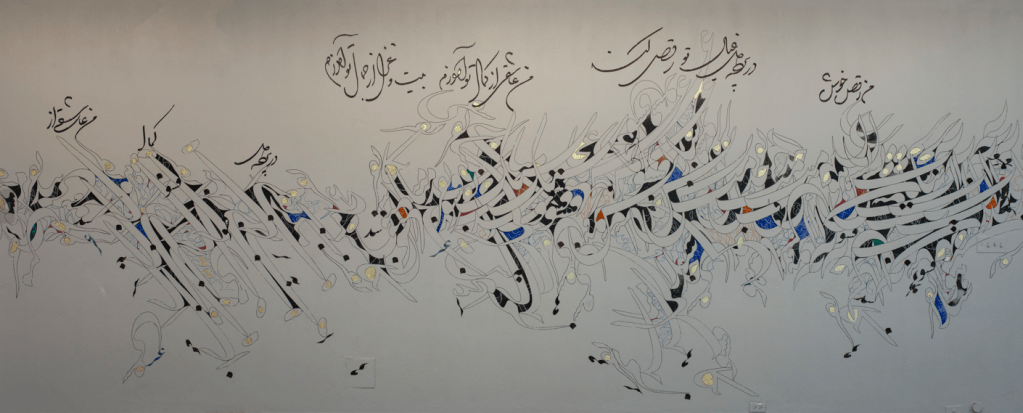
The mural featured four poems by the 13th-century Persian poet Rumi. Each poem was presented with translation and contextual interpretation, inviting viewers into the layered meanings of the text. The mural was created by master calligrapher Alibaba Awrang, originally from Central Asia and now based in Connecticut. His practice reflected both classical discipline and contemporary expression, breaking traditional boundaries while honoring the structural principles of Persian/Dari calligraphy.
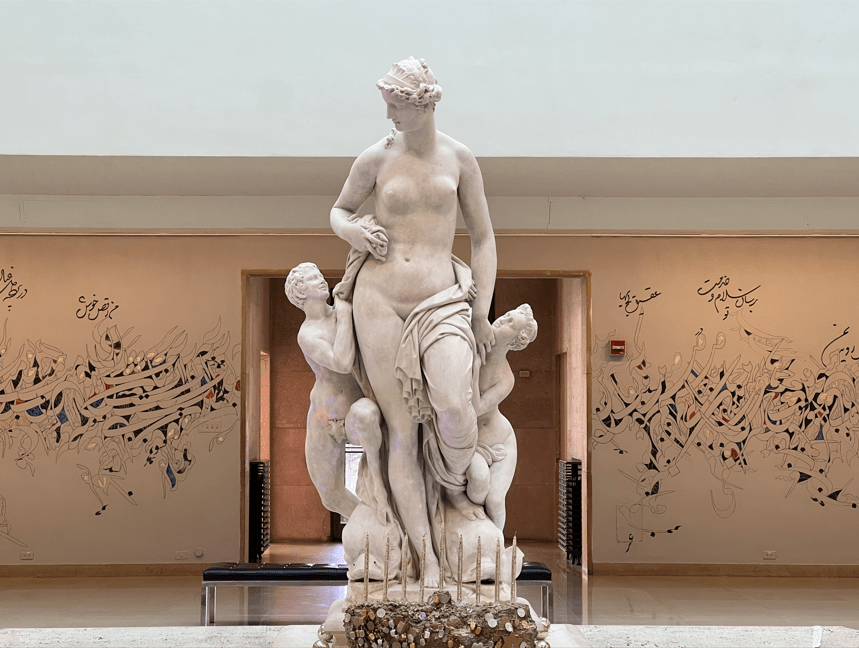
The mural was installed in the Avery Courtyard, where the iconic Venus sculpture by Pietro Francavilla is located. The artist thoughtfully engaged the architectural space and the presence of the sculpture, creating a rare moment in which written and sculpted art were presented together. The dialogue between the flowing, biomorphic forms of Nastaliq, inspired by living and human forms and the sculptural body created a compelling visual conversation.
On the opposite side of the gallery, a calligraphic interpretation of The Creation of Adam by Michelangelo reimagined the iconic scene through the language of script. The juxtaposition created a powerful exchange between text and form, between word and body, between ink and stone.
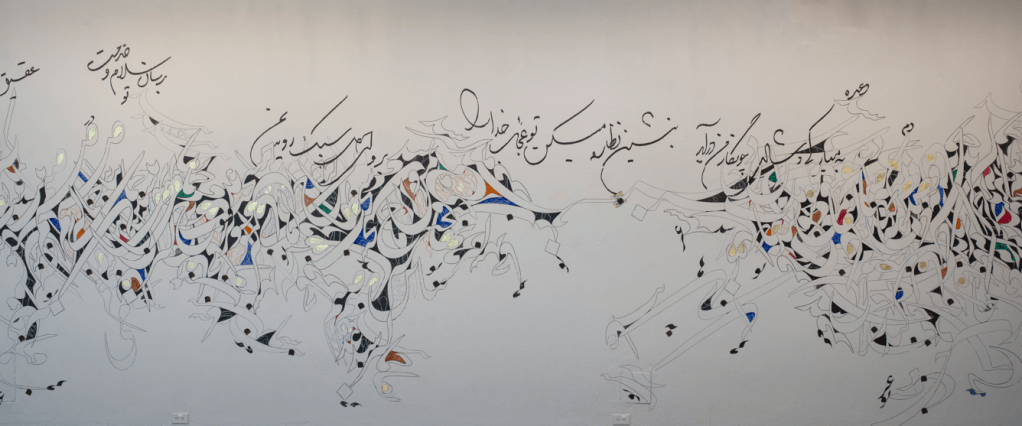
One of the poems presented on the gallery wall reflected the profound connection between love and the beloved. The beloved’s presence, though invisible to others, was deeply felt within the heart, inspiring the creation of art. The act of seeing the beloved within became the foundation of artistic expression symbolizing the transformative power of love and divine inspiration.
Here is the translation:
In your light, I learn how to love
In your beauty, I learn how to make poems
You dance inside my heart
where no one sees you, but I do
And that sight became this art
 Hamid Hemat
Leave a comment