1. Introduction
In the context of the Cultural Preservation of Traditional Forms of Expression a grant from the Department of State U.S. Mission to Afghanistan, Turquoise Mountain is carrying out an inventory and documentation of four crafts practised in Herat, Afghanistan. Selection and documentation of the crafts are governed by practical and ethical considerations defined in the 2003 Convention for Safeguarding Intangible Cultural Heritage, and the 2005 Convention on the Protection and Promotion of the Diversity of Cultural Expressions.
2. Methodology
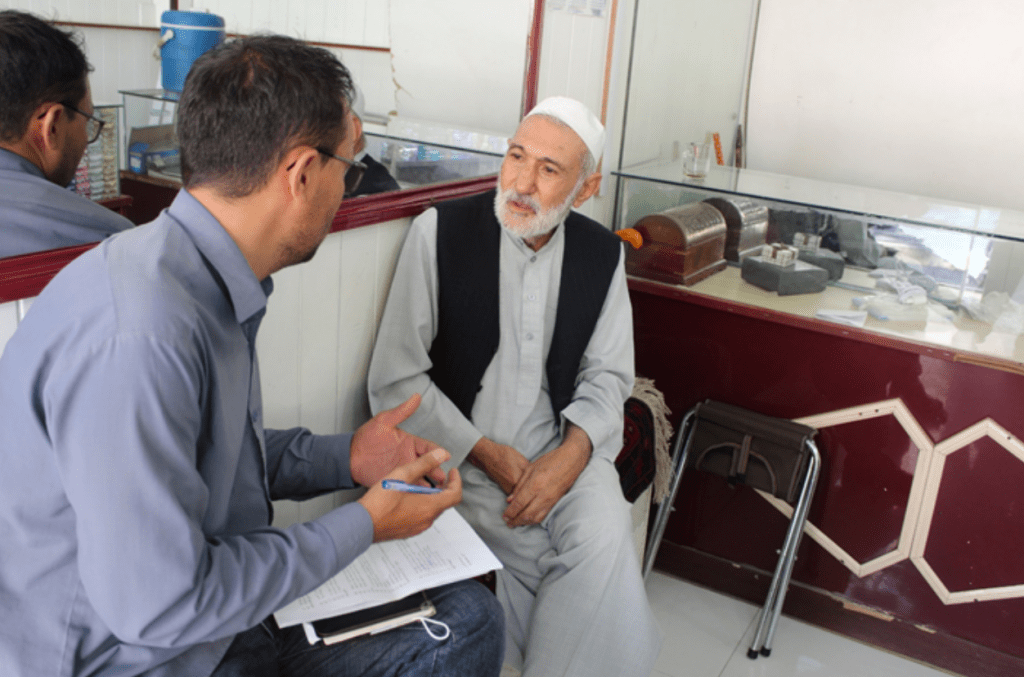
A total of two interviews were conducted during the process with 10 professional artisans. Interviews were carried out from within an ethnographic-social anthropological framework guided by the ethical guidelines developed by the UK’s ASA. Interviews with artisans remained semi-directed, although several directed questions were sometimes asked. All artisans were consulted before any information they shared was to be published and made accessible to a broader audience, and the final version of the video was approved by all stakeholders involved in it.
3. Craft status in the past
As the master recounts, “the rate of goldsmith products in the marketplace were highly good, however, in the past the only elite class folks could have purchased karat of 21 or 22.” He further narrated, “Poor people and middle-class people would have hardly afford to buy karat of 4, 6, and 7 to 14.” With the invention of new technologies the grade and karat of gold sizes have changed, while the prices skyrocketed up to manifolds and also the sudden proliferation of gold trading triggered the market growth incredibly high.
In retrospect, before the industrial revolution and development of science and engineering took place, the goldsmith production was utterly based on handicraft. All methods and techniques were needed to employ by handy tools and could have taken plenty of time. The quality of work was very high and the artisans often vehemently strived to develop new beautiful artistic designs. There was always kind of extremely competitive market; masters were highly engaged in inventing new designs in the marketplace. Interestingly, some of the masterly works of goldsmith workshops have had loads of customers even at the far-flung provinces of Afghanistan. The goldsmith production companies had been entirely operated by men in the society.
During the second and third quarter of the 20th century, specifically during Zahir Shah and later during the communist’s era, due to severe economic crisis the number of workshops operating in Zargaran Street (Goldsmith street) could roughly produce jewelry and the market demand plummeted down to its lowest level. At that time, rich people could establish workshops, the masters would only work as the employees in their workshops.
During the Mujahideen and Taliban the sudden changes in regimes stirred up the level of violence and civil wars over all the country. However, myriads of workshops had been destroyed while most of the goldsmith producers had changed their occupation and loads of them left the country in mass exodus. The precipitation of subsequent untenable conflicts in the country left most people including the goldsmith artisans with great level of destitutions to continue operating their goldsmith workshops. These caused the producers to turn into foreign markets.
However, with the dawn of the 21th century and sudden collapse of Taliban regime, majority of war-affected goldsmith masters began reopening their workshops and continued producing jewelry in Herat market. Moreover, since then, the goldsmith and jewelry market has been booming rapidly while the gold grade went up and new tools, methods and techniques used widely in goldsmith workshops. Also, with the rapid proliferation of different designs and jewelry models of goldsmith products in the marketplace beefed up the market demands to manifolds and the number of workshops increased dramatically. Nowadays, all of the essential workshop tools are electrical and mechanical. The traditional methods had been disappeared gradually as the war ended.
The electrical machines facilitate grounds for masters to produce variety of design. As Seddiqi a goldsmith master in Herat expressed, “the traditional methods and designs of jewelry required no electrical or mechanical instruments in the past, and their works were absolutely fascinating and delicate all steps of working were hand-crafted.” He further added, “In the past, we made bracelets in three days, today we can make the same design in three hours.”
In ancient times, goldsmith was considered one of the indigenous arts of Herat. However, majority of goldsmith workshops were located in Herat, expertise of goldsmith masters famously recognized among community.
In contemporary times, the traditional designs and models overshadowed by newly invented mechanical designs in the marketplace. Nowadays, in Herat, designs are made based on the order of customers which utterly do not have artistic design.
4. Meeting the Practitioners
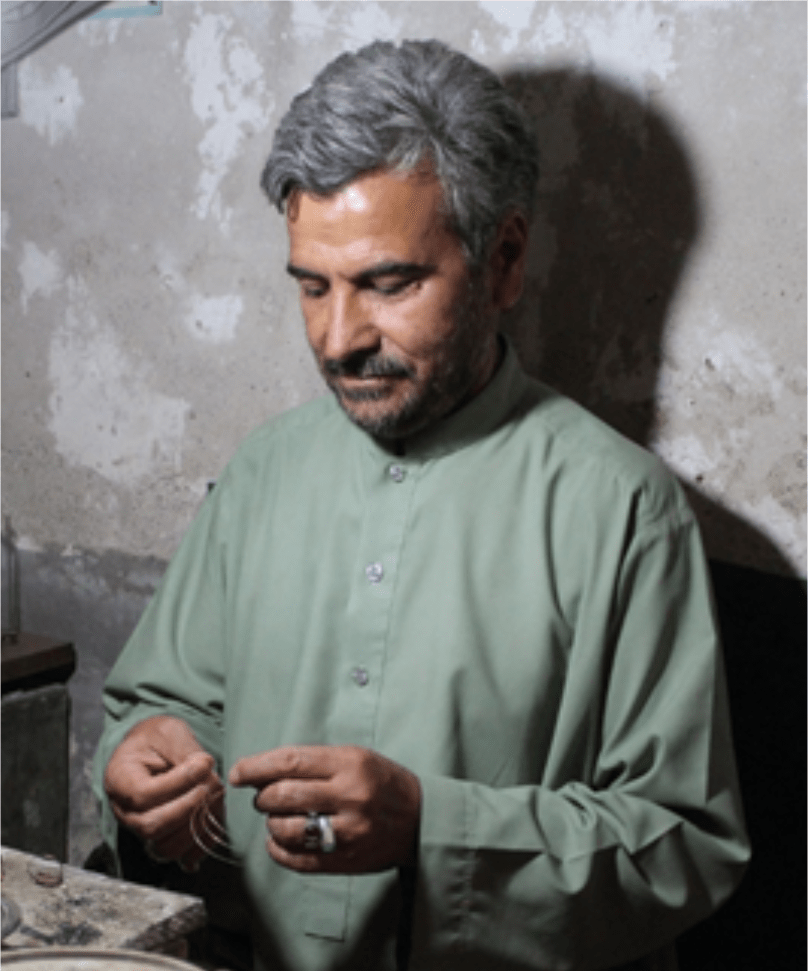
Fazal Ahmad Seddiqi
Fazal Ahmad Seddiqi is one of the eminent and accomplished goldsmith masters based in Herat. His profession is to repair golden ornaments and jewels. However, Seddiqi is 54 years old and has been working in this profession for nearly 44 years. At the age of 10, he started to learn this profession. During his entire life, Seddiqi often got many frequent orders for making jewels. His father Gul Ahmad was a renowned professional silk-weaver based in Herat.
Though his father profession was utterly unrelated, he had always been interested into getting himself established in terms of goldsmith profession. Since the very inception of his apprenticeship, he worked under the supervision of well-known Khalifa Younus for 4 years to get familiar with casting work in workshop. Soon after a while, he has started working with Jawad Zakari for three years before becoming a professional student at the Hajji Abdul Ali workshop for another 12 years. However, at the age of 30, after many years of its experiences, he moved to Mashhad, Iran, where he worked for 19 years and became a professional master after five year of work and become senior assistant of his master Haji Abullah in Mashhad.
After his return to Afghanistan in 2013, he decided to operate goldsmith workshop independently and became a professional jewelry repairer. Throughout his life, he taught at least 13 students. Currently, he teaches one student in his workshop at Arbab Zada serai in Herat old city.
Haji Ghulam Reza Jawaheri
Haji Ghulam Reza Jawaheri is one of the well-known contemporary accomplished and distinguished Goldsmith masters based in Herat. He is 75 years old and has been working as a professional goldsmith master for nearly 50 years. However, his father Ghulam Haider and Grand-father Ghulam Hassan were considered as one of the renowned and professional masters of goldsmith in Herat. From the very beginning, he learned this craft under his father’s close supervision and later on kept practicing this craft with his uncle’s workshop Haji Rahmat Jawaheri in the old city of Herat.
Since his childhood, Jawaheri had a keen interest in getting himself polished in terms of learning this craft while the legacy of this profession traces back to his reverent ancestors. Since he became a professional master in this craft, he taught at least 20 students, the techniques and styles of goldsmith of what he learned.
Jawaheri, in his entire life, had produced many Iranian Pahlavi coins which are famously known throughout the Herat. However, he also built many detailed and convoluted precious tapestry jewelry which today rarely exist in the market.
5. Tools
For many decades the devices and tools of Herat goldsmith have not changed. In the past, tools were typically made of iron in the city forging and some of them tools were also imported from abroad. While conducting jewelry, Latches, the crow nippers, scissors, fireproof board, magnifying glass, soldering and welding materials and the hydrochloride are the main component need to be available in a basic workshop.
Naturally, the pure gold color is light yellow. In fact, before using the gold, it characterized by titration process to properly conform its purity and softness. Initially, after the titration process completed the gold is then alloy with other metals to increase and maintain the degree of its hardness. Moreover, in the past, the method for examining the purity of gold was different, it was to tapping the metal or adding aqua regia on it, but nowadays, the grade of any kind of gold is determined by the karatmeter. However, the higher the grade of gold, the less hardness it is, and the more pure it is, the less carat is firm and stable, but it’s a little impure and mingled.
Gold categorized by its purity and carat and the highest grade is carat 24 and there are other grades could be found in the market such as 22, 18, 14, 12, and 10. Usually, the carat shows the amount and combinations of gold and other metals. The 24-grade gold is pure; it is very mild and heavy, but not resistant and impossible to make ornaments. However, if it changed into a grade 18 would be a bit tighter and more resistant to various shapes and designs. The price of gold is measured based on its carat, a high-grade is high-prices, and low-grade is low-priced.
Although the yellow gold is commonly used, it finds in different colors, the color of gold is associated with the type of metal which is alloyed. Usually, the white gold nickel metal alloy is used in goldsmith commonly. The copper is used in goldsmith to make red gold “rose gold”, while the green gold achieves from combination of silver and gold. However, other colors such as blue gold, purple and turquoise gold are also made of various organic compounds. Generally, in Herat the yellow, white and red gold colors are used widely.
Literally, making jewelry depends on the design, shape and its dimensions. To make a simple ring perhaps would take one or two hours, but if some designs required ornaments may take two or three days, whereas with new devices it would need 5 to 6 hours to shape a design and ornamented pattern.
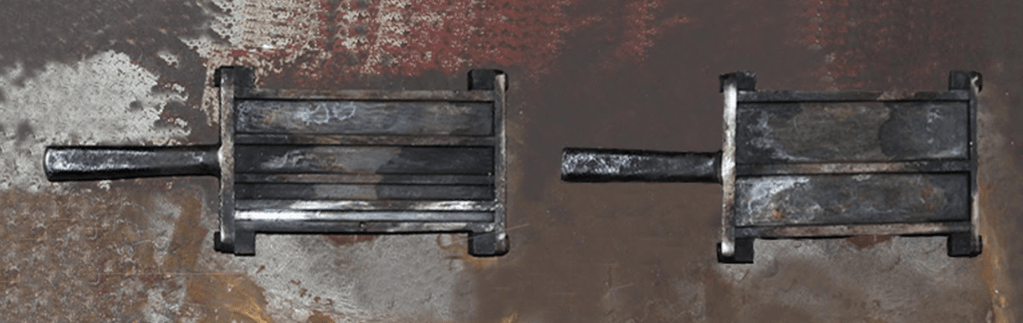
However, to create golden ornament, initially the gold is melted then a part of it will be poured inside device to merely build narrow and slim bars. Afterwards, the process begins by heating and tapping the main body of ornaments to be shaped and welded together at the end of the relevant section and finally polished.
In fact to purify the gold, the goldsmith master melts the gold and added to an aqua regia device to wipe out its gross and extra material. The purified gold is then subjected to a grade by titration test. However, gold measuring unit is gram in Herat and the size, design and weight is determined by the customer’s request . Also, it is feasible to make an ornament with different dimensions and weights, though.
Ingredients which are useful in goldsmith are Hydrochloride, Phosphoric acid, Water, and Borax. In addition, some materials are also used to color jewels to obtain its original colors, such as nitrate and salt solution.
However, different designs and patterns have been used to create the beauty of golden ornaments, including flowers, leaves, geometric shapes, animal shapes, birds and natural or historical landscapes. The creation of several pattern and design had been done by hand in the past through tapping and crinkling the golden warps and welding. Nowadays, it wholly depends on casting with a set of devices. For inlay and gem, materials such as precious stones with different colors and agate, garnet, jasper, azure, ruby, turquoise, diamonds, amber, pearl, topaz and emerald were used. But today these methods have been gradually disappeared.
6. Market Sale
Currently, the market demand is running high and is considered one of the highest paid jobs in Herat. However, gold jewelry’s customers are merely high elite class and middle class folks from society while most of them are female. Usually, the market demands soars high in eids, new years and summer. The market shrinks during the period of Muharram and Ramadan.
Nowadays, Herat’s gold production services are having a large number of customers in Herat and as well as other provinces like Kabul, Badghis, Ghor, Kandahar and Balkh. However, in the past, Herat jewelry has had a high reputation throughout the country, but for the time being, the customers are not looking for the quality of artistic work, they turned to foreign models.
7. knowledge Transmission (Ustad Shagirdi)
Enrolling as a student in goldsmith workshop due to the dealing with gold and precious stones, it requires to be a member of the master’s family or any other who has to have referenced by one of close family members of the goldsmith masters. Literally, it takes four years for new-comers to enhance the skills and techniques of goldsmith practically in the workshops. First and foremost, the students must get familiar with the work environment and tools, and then closely observe the working process to get acquainted with the methods of working and usage of tools properly. However, afterward, they are allowed to practice on simple and easier items or repairing jewels so long as they become fully acquainted with the techniques of goldsmith production.
After getting familiar with the tools and techniques, students are then, should learn the methods of soldering or combining the materials such as nitrate and borax. However, the last step into becoming a full-fledged master of goldsmith is to practice the variety of designs and patterns and work on the methods of designing an ornament. However, nowadays, with the invention of new machines the process of learning the goldsmith production changed, students now have to learn the machine works and set up of adjusting the molding machine.
8. Threats
Currently, this profession is receiving no threats. Workshops are operating peacefully without any impediments in Herat old city. The only colossal severe problem which sometimes threaten the masters and goldsmiths is insecurity throughout the country. The Herat’s traditional technique of goldsmithing is gradually diminishing with the evolution of newly electronic machine while the prevailing adaptation of foreign designs and patterns saturated the artistic and creativity of the past goldsmith works in the marketplace.
9. Production Sequence
To produce jewelry products, the goldsmith follows several steps and methods during the production process. In this process, the goldsmith usually uses pure or used gold materials. However, the amount and grade of used gold will be determined initially and then can be melted and poured into molds properly. While using pure gold, its amount will be determined first and then the melting process begins and the amount of alloy will be added to produce jewelry.
Alloy
Alloy is a metal mixture that literally combines with pure gold while melting. In fact, pure gold is flexible nature and its actual durability and strength are low to make jewelry, however, to strengthen durability, the goldsmith has to mix other metals such as copper, silver, brass, nickel, and zinc or a blend of these types of alloys during the production process. Moreover, the amount depends on the weight of pure gold which is actually 25% percent.
Gold Titration
Raw material is procured ether by purchasing pure gold or used from local market and families. While working with used gold, essentially the master determines the karat of gold by karatmeter. Titration is a process which shows the amount of mixture of pure gold with another substance metals. The pure gold is 24 karat. Meaning no metal is combined. Usually, gold in Herat market could be found in 22, 21, 18, 16, 14, 9 karats. There is a simple calculation method in titration. Whatever number come from less than 24 karat the remaining is supplementary substance metal that has mixed with gold. For instance, 18 karat gold, is combined from 18 karat pure gold and 6 karat another metals.
Designing
Designing is the preliminary step during the jewelry production process as it is considered as an artwork. In retrospect, the designing method was utterly different. They often draw design on paper whereas in contemporary age goldsmiths use computer software for designing.
Sometimes designs can be drawn and engraved on the plastic molds through producing the waxy patterns. However, to produce the waxy patterns, the goldsmith master initially makes mold and then engraves the designs on the surface of produced mold properly. Designing always start from bigger surface and extend to the tiny areas.
Casting
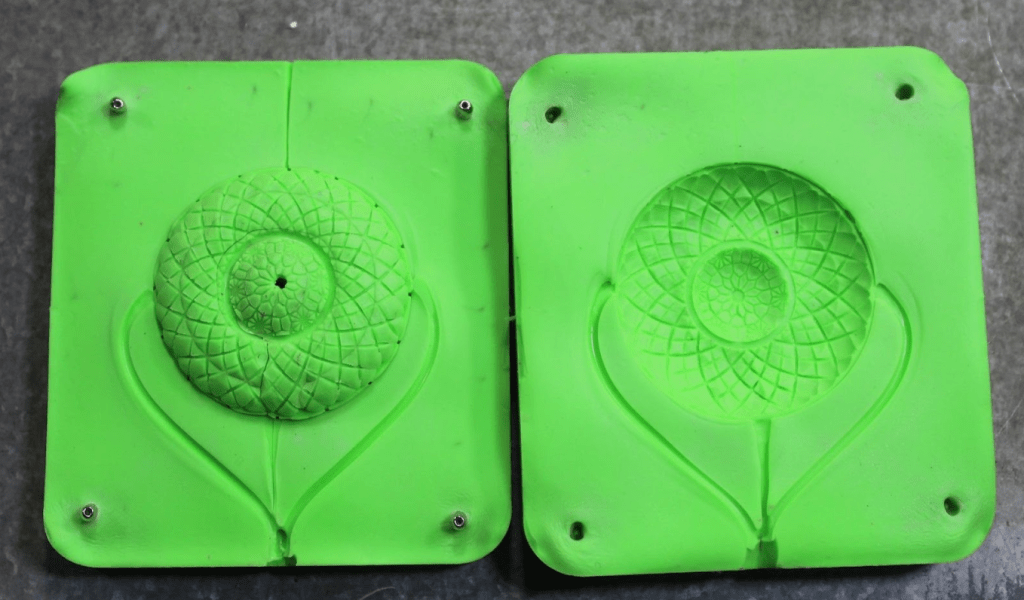
Making Molds: After the designing process is finished masters will send the design the Iran to prepare the plastic mold for them. Usually the mold casting has two parts, which fixed tightly together and there is a hole to pour the wax in it. The will be heated about 80 centigrade and pumped into the plastic mold by pressure to make sure the wax reached all parts of the mold completely. After five minutes of wax ejection the mold will be opened, and the wax will be observed closely if it still requires extra parts to cut or add.
Cylinder: when the wax is ready, the master will past the wax around the bar and will be placed inside the cylinder tube he will make sure to close all the hole of cylinder with rebar tape. Next process to mix gypsum with water and pour inside the cylinder. While pouring the gypsum in the cylinder the master will place the cylinder in vibrator for 5 minutes to make sure all the cavities filled tightly, and the inside air sucked out. Then the cylinder brought out and let to dry.
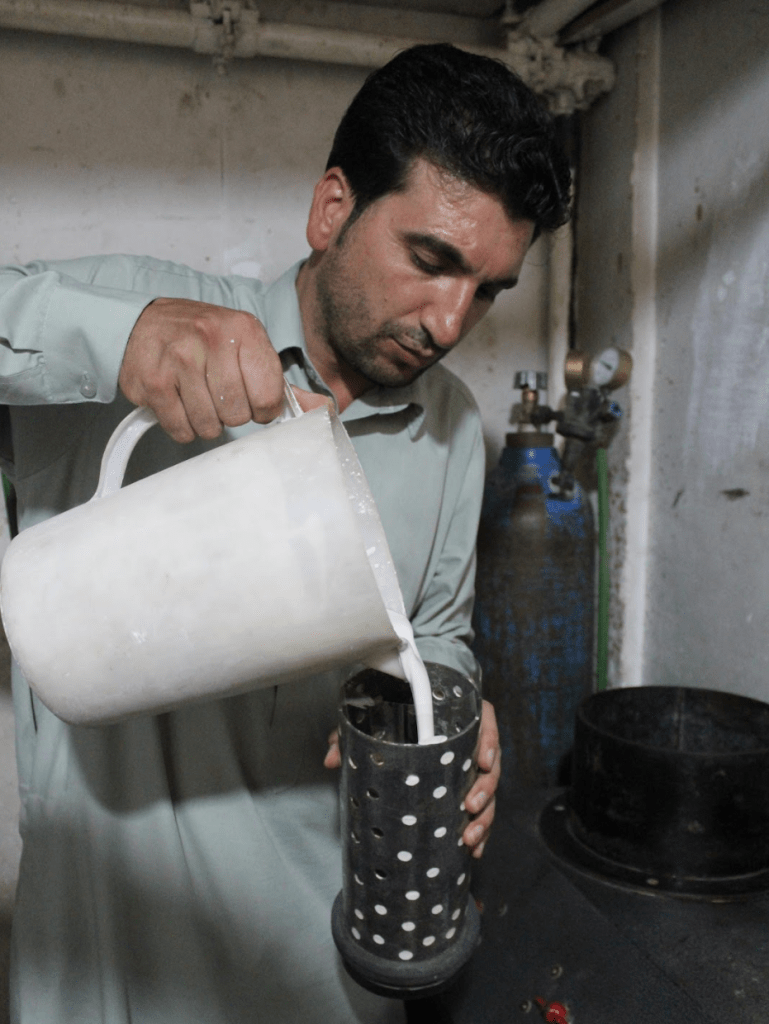
Kiln process
Wax heating kiln (کوره موم سوزی): When the cylinder dried, it will be placed in wax heating kiln and start the fire for about 3 hours with 300 centigrade temperature. During this process all the wax inside the cylinder will dissolved.
Annealing Kiln (کوره پخت): Cylinder will be placed in annealing kiln for next process. It is because to bake the gypsum inside the cylinder and hoist the resistance of the gypsum which later melted gold will be poured in it. This time the cylinder will be heated to about 750 degrees centigrade for 4 continuous hours. Lastly, the cylinder will be placed in open air to cool down its temperature gradually.
Melting
There is old and new technique for melting the raw gold. Today the old method is not used any more which is burning fossil fuels under the crucible until the gold melted.
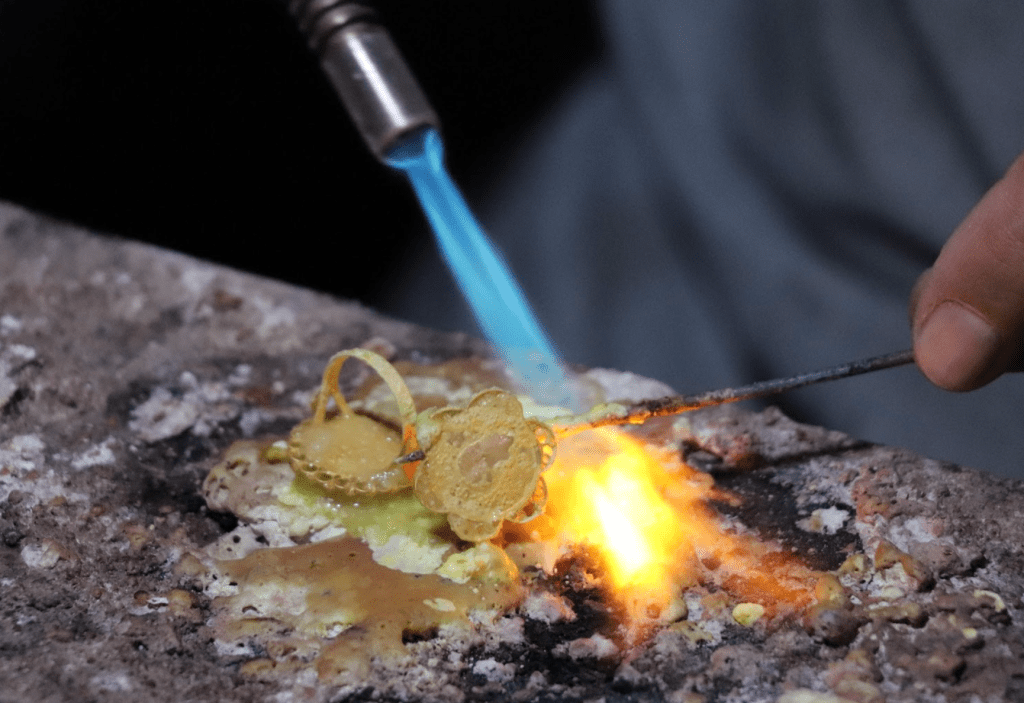
Now, masters are using torch gas heating technique which directly heat up raw gold around 1200 centigrade. Also, during the melting process the master put some amount of borax in the crucible to amplify the heat temperature to melt instantly. This technique takes less time and economically it cost cheaper compared to the old method.
Once the gold completely melted. The molten gold poured into cylinder main hole carefully and continuously till the cylinder become full. The master than let the cylinder for 5 minutes to cool down. Lastly, the cylinder will be put in cold water for several time and bring up this process will eliminate the gypsum from the cylinder and gold.
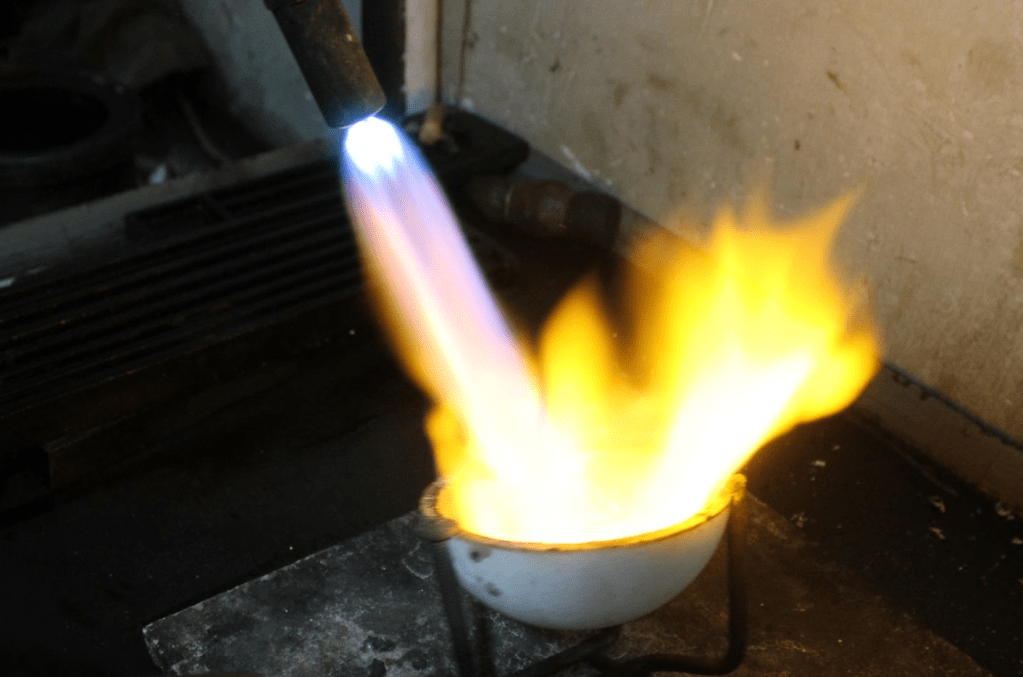
Joining and Shaping
When the gold removed from the gypsum cast, the master will put all the pieces in an electronic device called magnet device. The magnet device will vibrate for 20 minutes and remove ashes, small particles of gypsum from the gold. The next process is to start joining the jewelry fragments together. Soldering is one of the most important steps to attach jewelry-related parts together to make the main body and structure of a jewelry.
By soldering many pieces of jewelry attached to make final structure but some pieces attached by bending or pressing the edges of two pieces and some of the pieces are attached by chains.
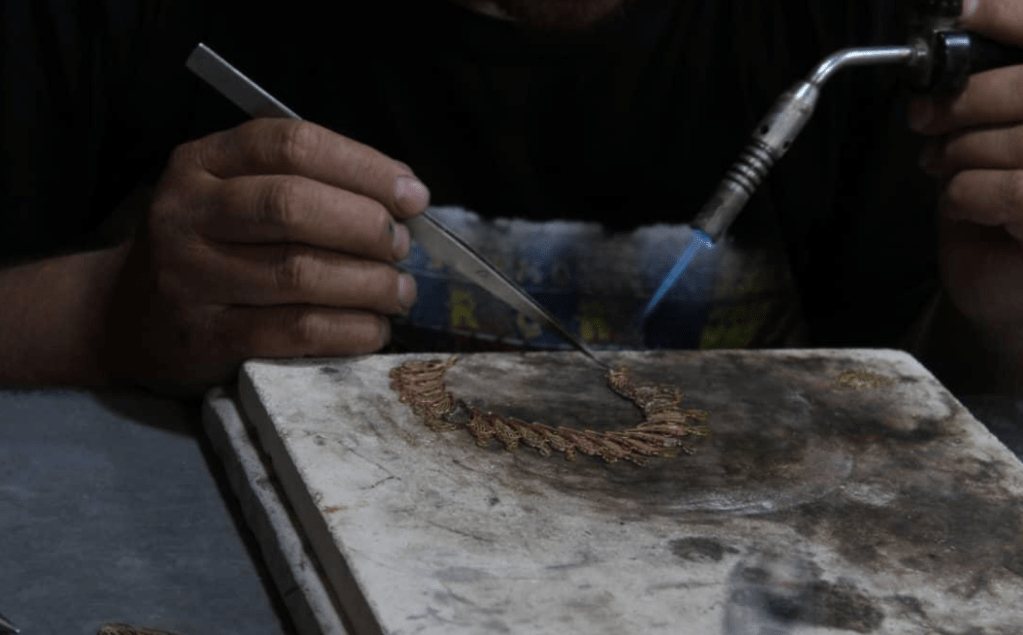
Polishing
Polishing is the most interesting phase in jewelry production process since a master will get back the price of his hard work while see the shine and beauty of the artwork.
In the past masters used leather and felt to polish the gold but today Herati master use electronic devices to polish in 3 step process.
1- The product will be placed in magnet device with dishwashing liquid and warm water for 20 minutes.
2- The gold will be placed in hot Hydrochloric acid for 4 to 5 minutes and then put in cold water to make a shine and looks whitened.
3- Lastly, the gold with be placed in aqua regia for one minute to obtain original color of the gold and washed with dishwashing liquid and water for the last time.
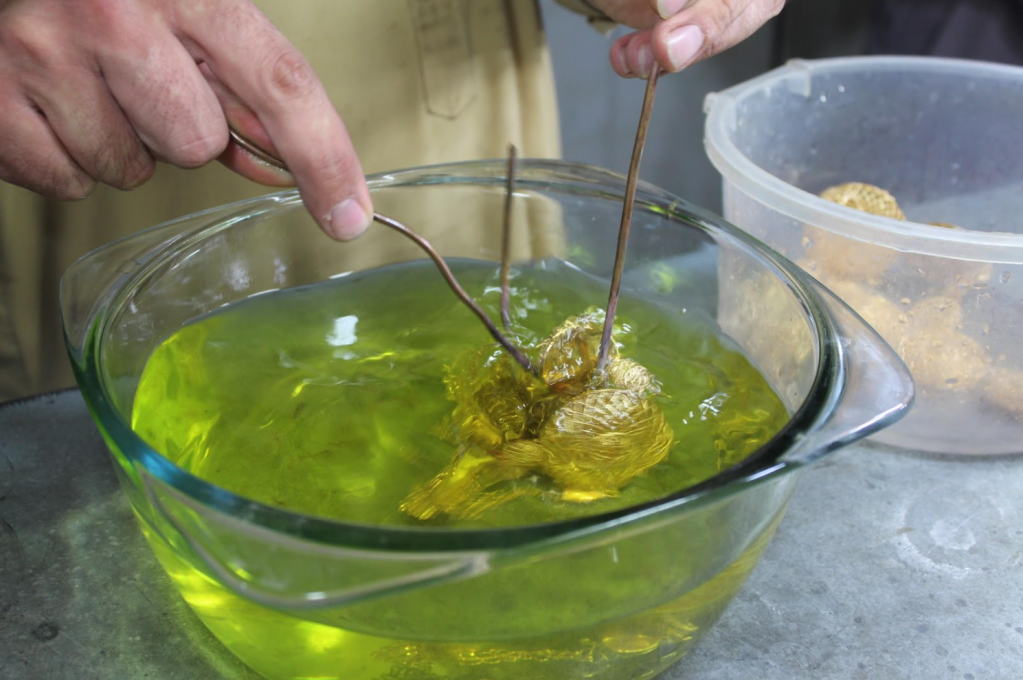
Finishing
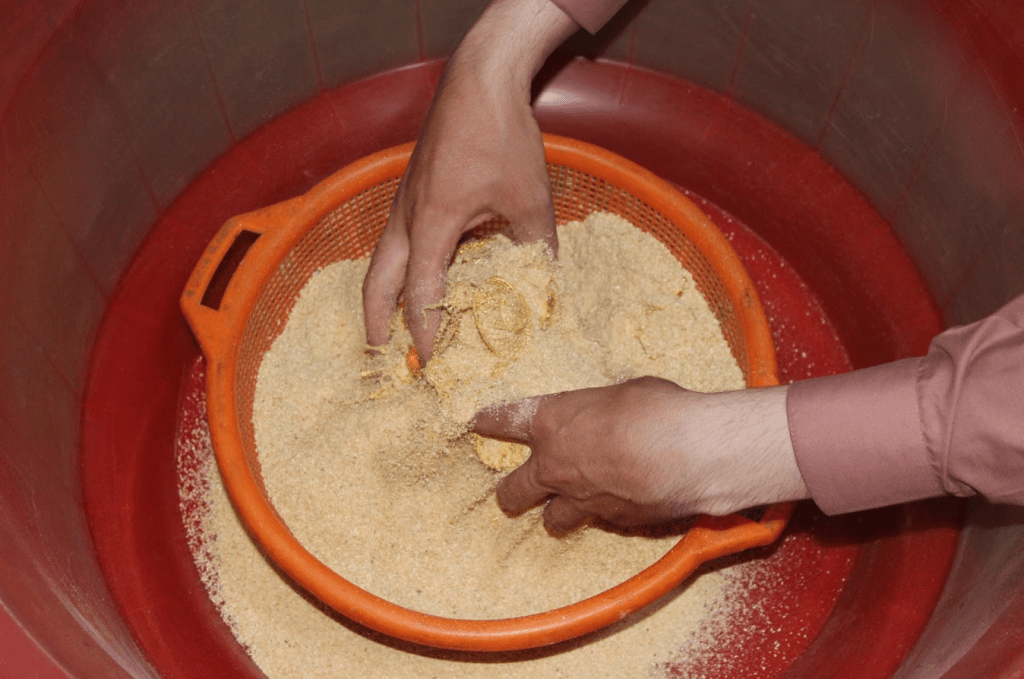
Sawdust is used to dry the jewelry. If jewelry dried in the open air, it caused stain on jewelry surfaces and remained sign of water drops. sawdust dries, clean and brighten the jewelry with no stain. Sawdust placed in a plastic basin then the Jewelry put in it and covered by sawdust for 15 minutes to be dried completely.
Finally, jewelry gave to Union of Goldsmith of Herat to check the titration and quality, if the quality was ok for the market the gold will be put in shops showcase for selling.
10. Tools
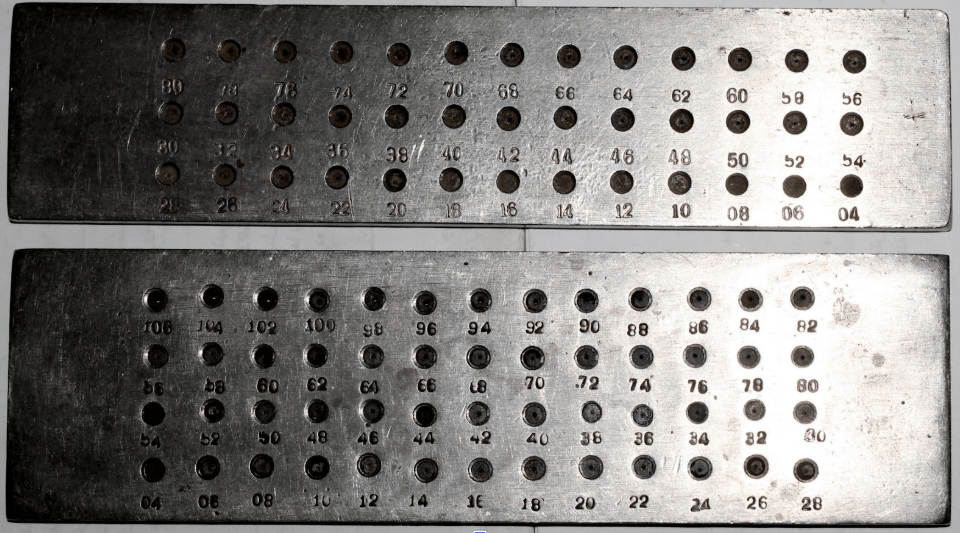
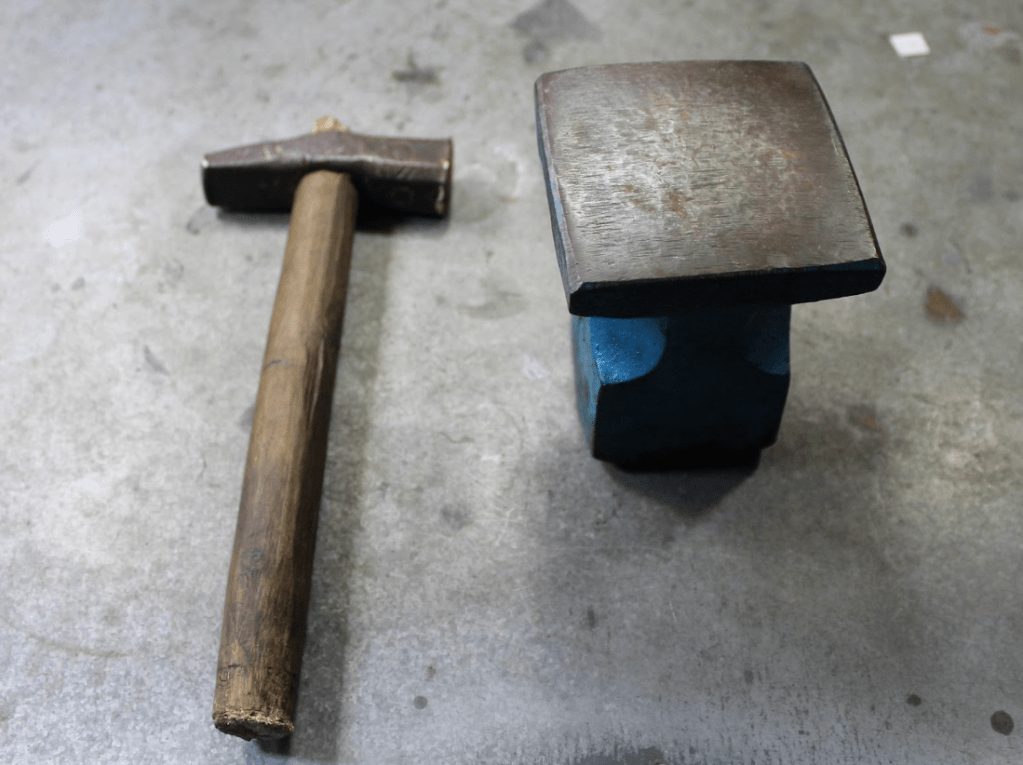
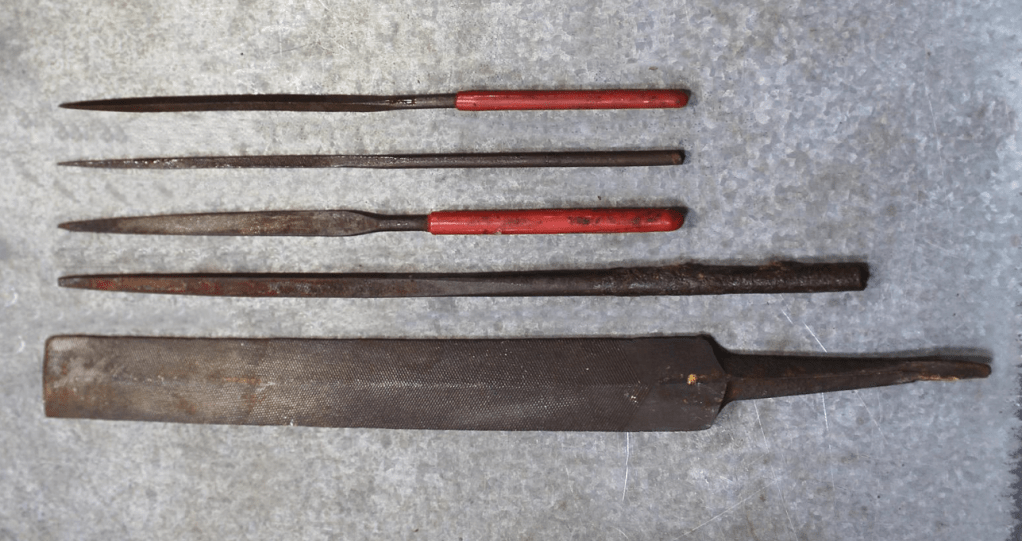
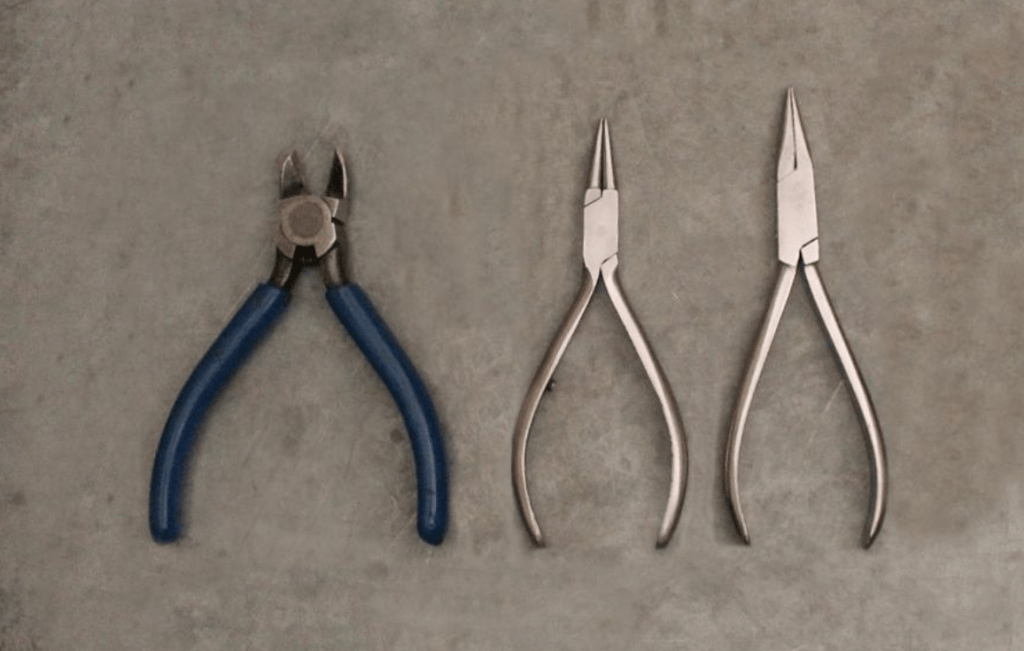
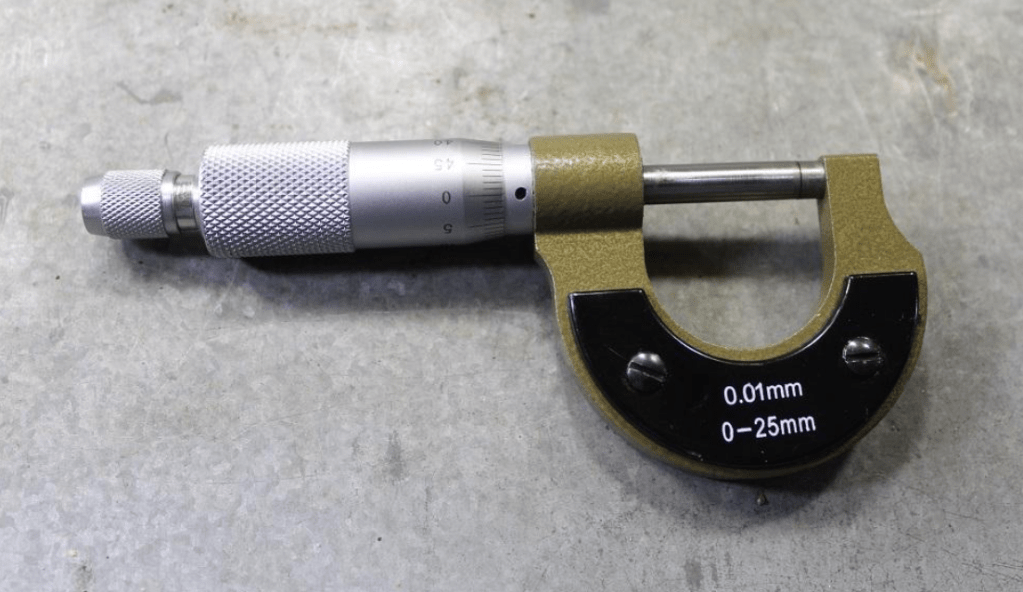
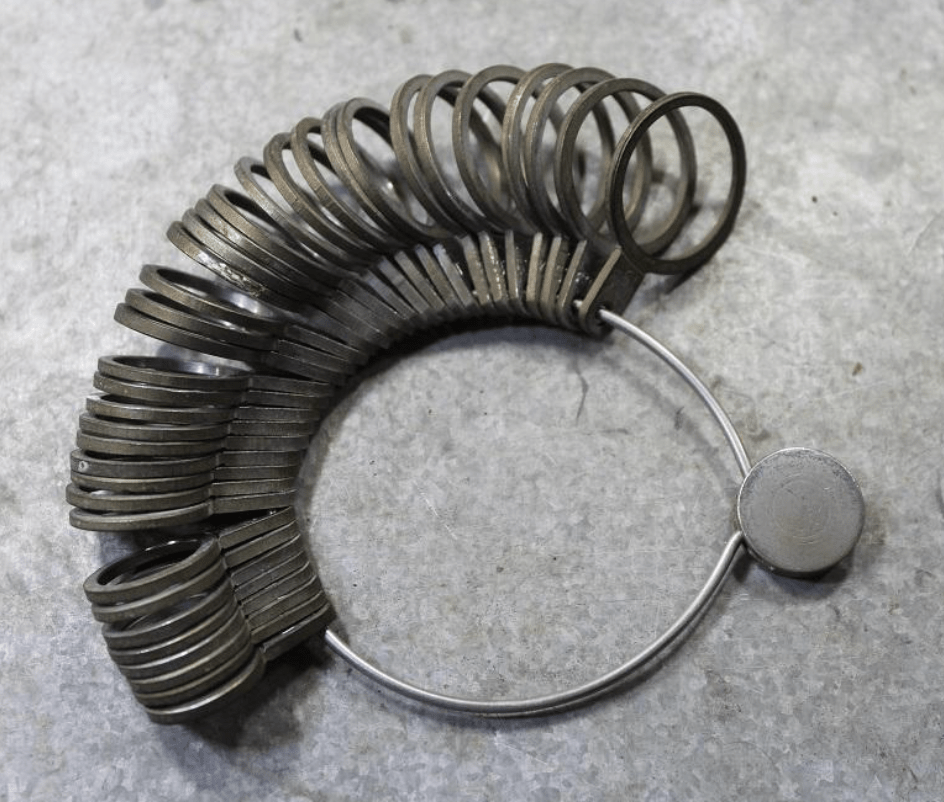
Worktable (میزکار): Worktable plays a vital role in this craft, which is mostly made of wood with a small fireproof board made of stone and placed at the middle of the table. The table has about 10cm Ledge on three opposite side of the master. This is because to stop the gold particles from falling down during the production.
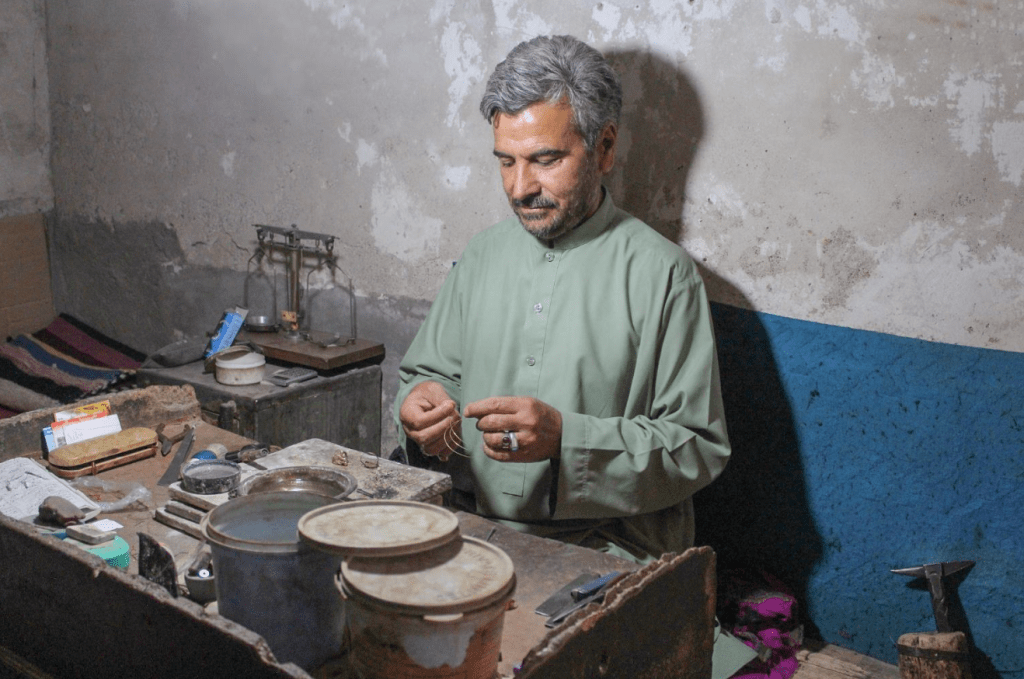
Magnifying glasses (ذره بین): Magnifying glass can be used to look at the delicate and small particles of gold during production process. However, it has many shapes and sizes.
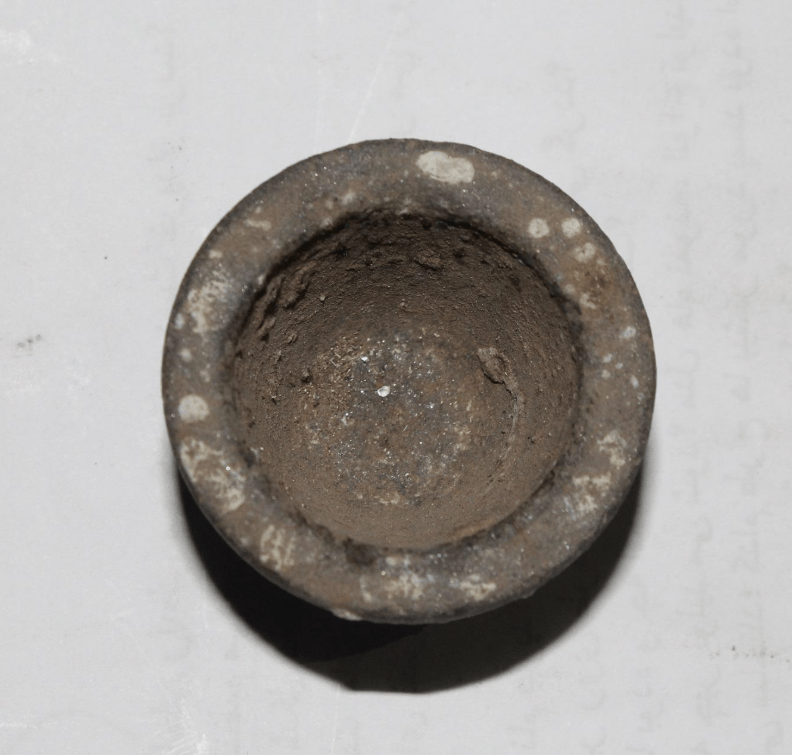
Crucible: Crucible is a ceramic or metal container in which substances are heated and melted. This device comes with a variety of sizes and shapes.
12. State of Craft
Goldsmith in Herat has been prodomnatly family profession and business, the communities who practiced the craft were from the mid class of Herat society. These families were lived mostly around the zargaran alley or goldsmith street, Charso and generally in the old city of Herat. 50 years ago, goldsmith workshops and jewelry shops were located in zargaran alley where practiced by more than 15 experienced masters and about 2 to 3 apprentices in 10 workshops. The number gradually decreased during the Communist and Mujahideen era due to instability and civil war. The number of master’s declined to minimum during the Taliban regimes due to lack of market and poor economy of families in Herat and overall Afghanistan.
After the fall of Taliban in 2001 the situation changed, goldsmith and jewelry market has boomed rapidly. Gold trades between afghanistan and region countries restart and The number of gold merchants and jewelry shops increased dramatically. Demand for gold and precious stone in families once again place the goldsmith workshops to start competition and produce delicate and new designs.
Workshops are imported modern electrical machines and learn new techniques today there is not any workshop to work in classical way of jewelry production. Today it is roughly estimated that around 45 to 50 workshops with 3 to 4 apparantics in each are learning and working. More than 250 shops are selling in house produced and imported jewelry from Soudi Arabia, Egypt, Bahrain, Russia and Iran. These shops are located mostly in zargaran alley, lelami street, shahre naw and elsewhere in the city.
Jewelry customers are mostly women from wealthy families. Also, according to local tradition when a boy and girl get married the boy purchase gold for his future wife these families are also the majority of the jewelry customers. Jewelry production of Herat also has good market in Kabul, Kandahar, Balkh, Badghis, Ghor, and Farah as well.
Goldsmith products include bangles, necklaces, earrings, bracelets, ring, wedding ring, hair flower, belt, and crown. Today’s famous Goldsmith masters are Haji Ghulam Reza, Mohammad Asif zaragr, Haj Abdul Ali, Khalifa Ali Ahmad, Khalifa Ghulam Mohammad, Sharif Ahmad, Haji Sami, Fazl Ahmad Sadeqi, Jawad Attaie and Reza.
There is no any particular threat to goldsmith profession in Herat, transmitting the knowledge and selling the produced items are very good in overall Afghanistan. The insecurity is only problem that sometimes goldsmiths or jewelers have been threatened or kidnapped for money.
13. Acknowledgments
The ICH team would like to thank all those goldsmith masters who have worked closely with us and dedicated their time to answering our questions.
This research was carried out by:
Dr. Bastien Varoutsikos, project manager
Anthony Graves, researcher
Hamid Hemat, senior project coordinator
Reza Muzafari, project officer
Farhad Hamidi & Abed Bagramwal, interns
 Hamid Hemat
Leave a comment