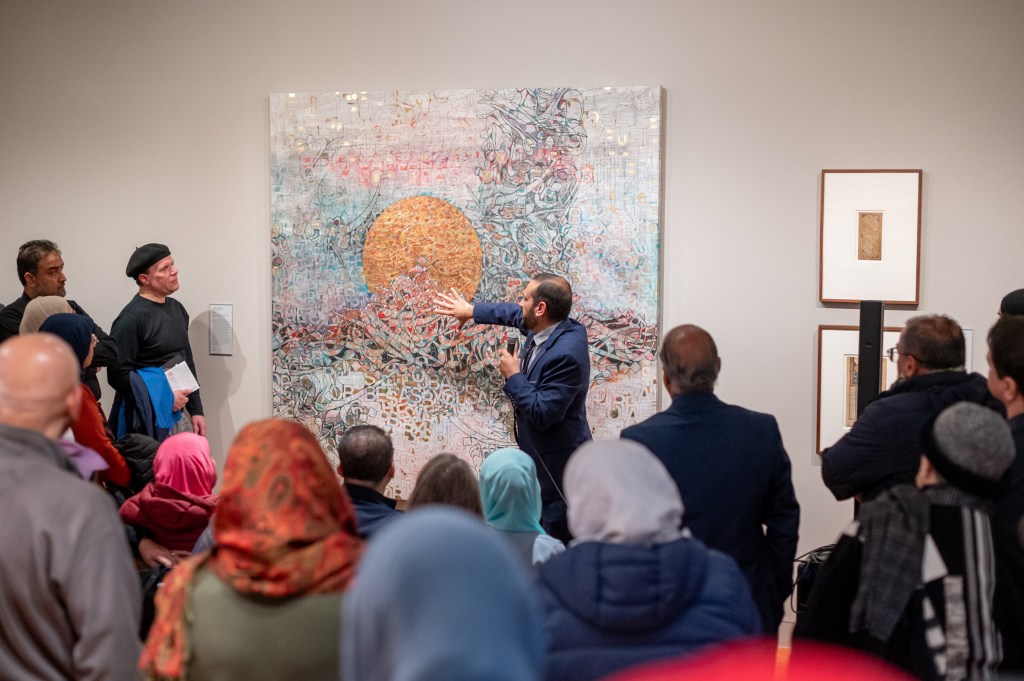
When I first began researching the Islamic works preserved in the study collections of The Wadsworth, I had no idea how transformative the journey would become. What I discovered was a world of extraordinary beauty and knowledge, objects spanning more than 1,200 years of history, quietly resting within the museum’s metalwork and works on paper collections. Many of these works had not been seen for generations.That moment of discovery became the seed for Divine Geometry exhibition.
This exhibition brought together objects from North Africa to South Asia, tracing the artistic, intellectual, and spiritual traditions of the Islamic world across centuries. The Wadsworth’s engagement with Islamic art began over a century ago, in 1905, with a bequest from Elizabeth Hart Jarvis Colt. Since then, the museum has carefully built a small yet remarkable collection that reflects the diversity of cultures across Asia, Africa, and parts of Europe connected through Islam. Divine Geometry was drawn primarily from the museum’s own holdings, complemented by modern acquisitions.
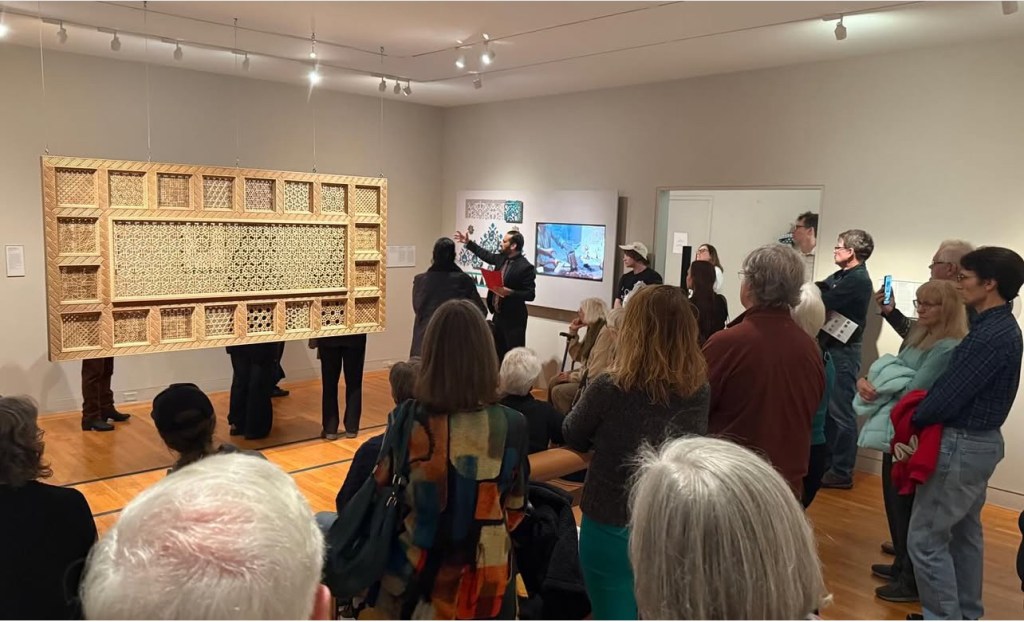
As I studied the collection, I realized that despite the vast geography and timeline, certain visual languages connected everything. I divided the exhibition into four thematic sections: Calligraphy, Geometric Patterns, Floral Motifs, and Figurative Art. Each section begins with an introduction that invites visitors into the ideas behind the objects.
Geometric Patterns
Geometric design in Islamic art is both mathematical and spiritual. Patterns begin with simple shapes, a circle, a square and expand into stars, polygons, and endlessly interlocking systems. There is no beginning and no end. Lines pass over and under one another, forming unity through repetition and symmetry. These patterns symbolize infinity, a reflection of the divine. Across wood, tile, metal, manuscript, and architecture, geometry becomes a universal language that transcends region, ethnicity, and time. In this section, viewers were invited to look closely and experience how patterns become meditation.
Floral Motifs
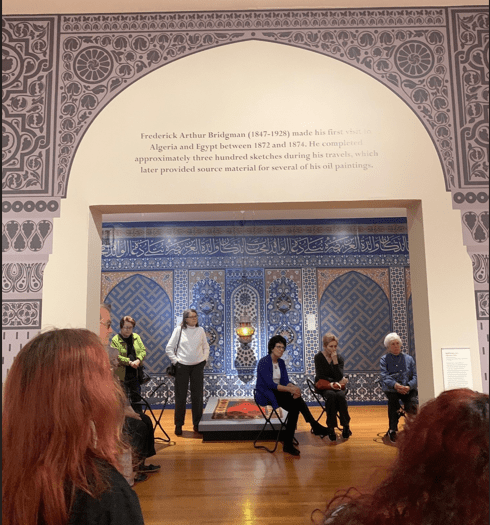
Floral and vegetal forms often known as arabesque or islimi, express growth, movement, and the beauty of creation. Spirals expand outward like living organisms reaching toward light. Although vegetal ornament predates Islam, it was refined and transformed across centuries. From Persian manuscripts to Mughal architecture, from Ottoman decoration to North African tiles, floral motifs evolved while maintaining core principles: repetition, balance, and rhythmic flow. These designs are not only decorative. They are symbolic, reminders of life’s continuous unfolding.
Figurative Art
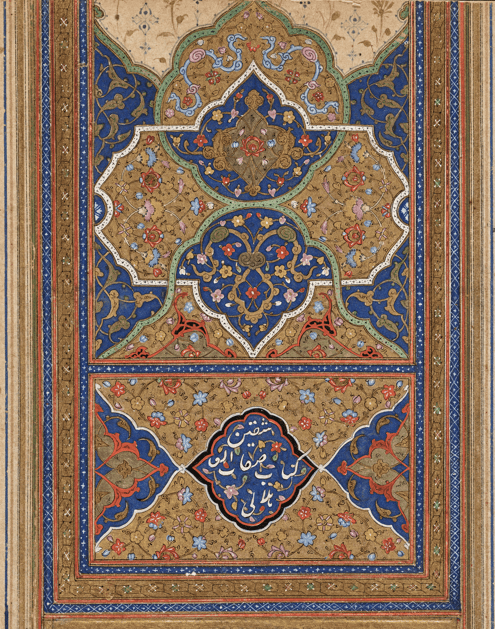
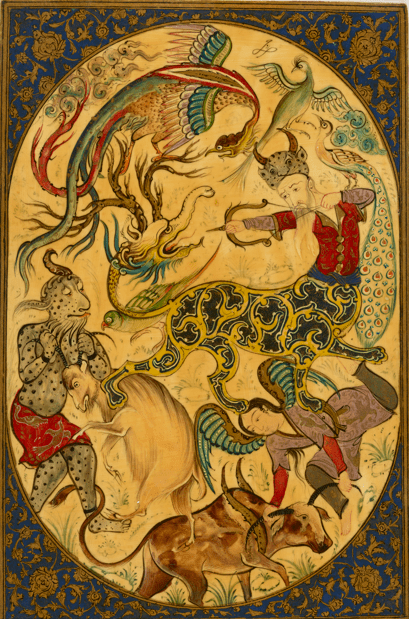
Figural representation in Islamic art is complex and varied. While religious spaces often avoided imagery, secular settings, manuscripts, palaces, courtly albums embraced it. In this section, the traditions of Arab, Persian, Turkish, and Mughal miniature painting were explored. Particularly important to our collection are works on paper connected to the Herat School of the 15th century in present day Afghanistan. Under the patronage of Shah Rukh and his son Baysunghur, Herat became one of the most important artistic centers of its time. The great master Kamal Uddin Behzad led a workshop known for refined brushwork, vivid mineral pigments, and highly developed compositions.
Featured Highlights
The Mosque Lamp
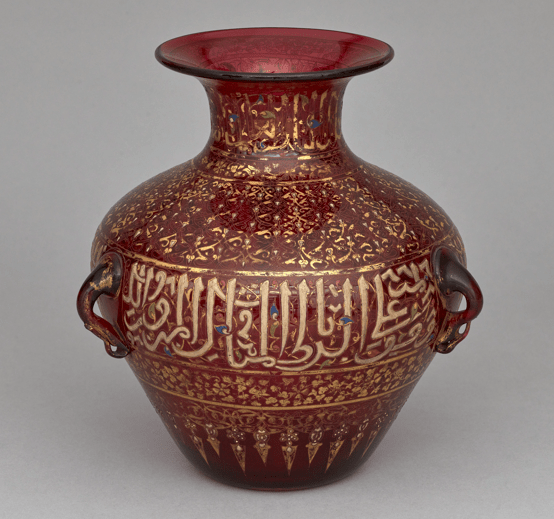
One of the most fascinating objects in the exhibition was a 19th-century mosque lamp created by Philippe Joseph Brocard in Paris. Inspired by 14th-century Mamluk glass lamps, Brocard’s work reflects a moment of cultural exchange between Europe and the Islamic world. Although visually faithful to Mamluk originals, the inscriptions are pseudo-calligraphy, decorative rather than linguistically accurate, revealing both admiration and reinterpretation. The craftsmanship is so refined that even experts sometimes struggle to distinguish these revival pieces from medieval works. These lamps tell a layered story of influence, imitation, fascination, and dialogue between cultures.
Calligraphy
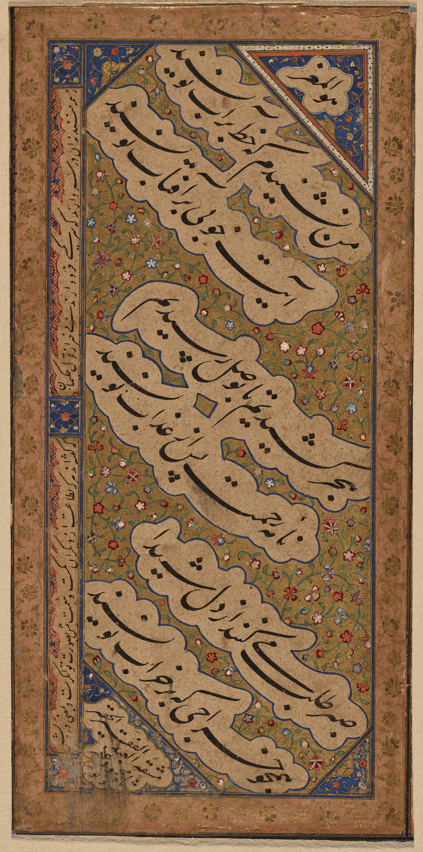
In Islamic culture, the written word holds profound spiritual significance. The Quran elevated writing into one of the highest art forms. Arabic calligraphy is not merely handwriting, it is devotion expressed visually. From early Kufic scripts to Naskh, Thuluth, and later Nastaliq in Persia, the evolution of calligraphy mirrors both artistic innovation and spiritual reverence. In this section visitors feel the quiet power of the written word, how ink can become prayer.
Immersive Animation
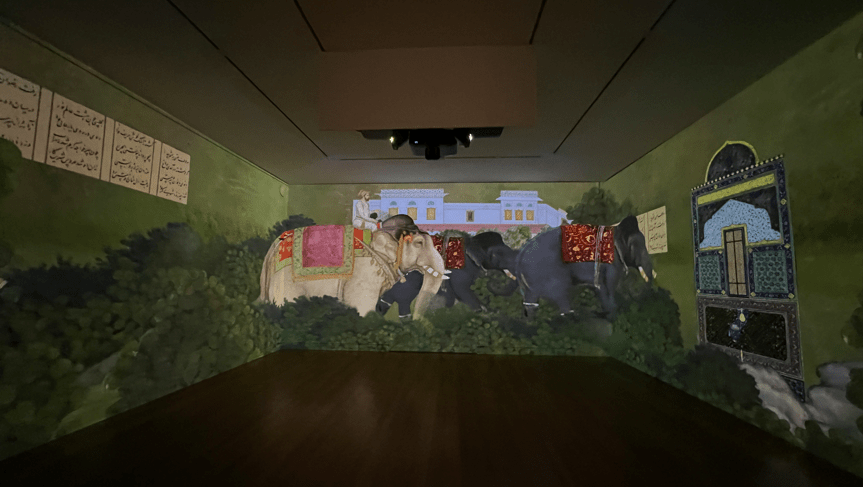
To connect past and present, I created an immersive digital installation where Islamic patterns and figurative elements move across three connected walls as one continuous screen. Accompanied by music, the animation allows visitors to step inside geometry, to feel surrounded by rhythm and motion. Islamic art is often seen behind glass cases. Here, it becomes alive, immersive, and experiential.
 Hamid Hemat
Leave a comment